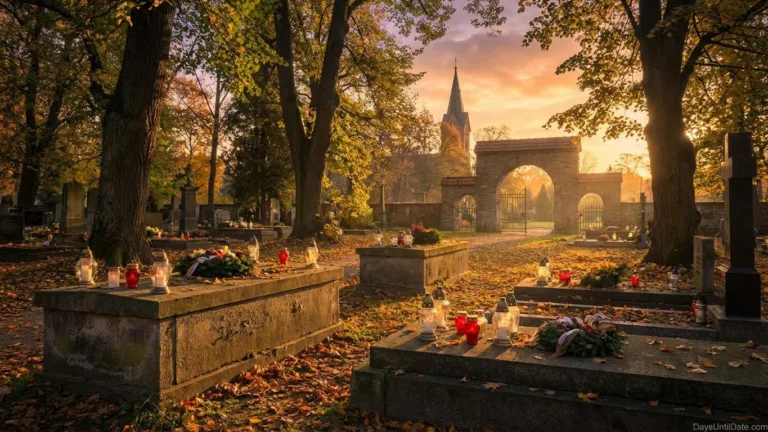
How many days until All Saints’ Day?
All Saints’ Day is on Sunday, November 1, 2026. There are 5 days left until All Saints’ Day. All Saints’ Day is observed every year on November 1.
Date & Planning Details
All Saints’ Day is observed every year on November 1.
All Saints’ Day Calendar (2026-2100)
| Year | Date | Day | Days Left | Weekend? |
|---|---|---|---|---|
| 2026 | November 1 | Sun | 5 days | Yes |
| 2027 | November 1 | Mon | 370 days | No |
| 2028 | November 1 | Wed | 736 days | No |
| 2029 | November 1 | Thu | 1101 days | No |
| 2030 | November 1 | Fri | 1466 days | No |
| 2031 | November 1 | Sat | 1831 days | Yes |
| 2032 | November 1 | Mon | 2197 days | No |
| 2033 | November 1 | Tue | 2562 days | No |
| 2034 | November 1 | Wed | 2927 days | No |
| 2035 | November 1 | Thu | 3292 days | No |
What is All Saints’ Day?
All Saints’ Day is a Christian observance dedicated to all saints, including those not named on individual feast days. In many Western Christian calendars it falls on November 1 every year, while some Eastern Christian traditions observe All Saints on a different date after Pentecost.
How People Observe It
Many people attend church services, light candles, visit cemeteries, pray for the departed, or spend time with family. Local customs vary by country and church tradition.
Calendar note
This countdown uses the November 1 Western Christian date for All Saints’ Day.
Date variation note
Some Eastern Christian calendars observe All Saints on the first Sunday after Pentecost rather than on November 1.
History and Background
The November 1 observance developed in the Western Church and became widely associated with honoring the full communion of saints.
Frequently Asked Questions
When is All Saints’ Day?
All Saints’ Day is observed on November 1 each year in many Western Christian calendars.
Is All Saints’ Day a public holiday?
It depends on the country. It is a public holiday in some places, while in others it is mainly a religious observance.
What does All Saints’ Day mean?
The day honors all saints, including saints who do not have their own named feast day in the church calendar.
Is All Saints’ Day the same as All Souls’ Day?
No. All Saints’ Day is on November 1 and honors saints. All Souls’ Day is on November 2 and is focused on prayer and remembrance for the departed.
Do all Christians observe All Saints’ Day on November 1?
No. Many Western churches use November 1, while some Eastern Christian traditions mark All Saints on the first Sunday after Pentecost.
All Saints’ Day Timeline
These milestones show how the November 1 observance became part of the Western Christian calendar.
Pope Gregory III dedicated a chapel in Rome to all saints, helping connect the observance with November 1.
Pope Gregory IV supported wider observance of All Saints’ Day in the Western Church.
The Roman Catholic calendar kept All Saints’ Day on November 1 while simplifying some related vigil and octave observances.
More Upcoming Days



This countdown uses the selected timezone to keep the live timer and date table consistent.