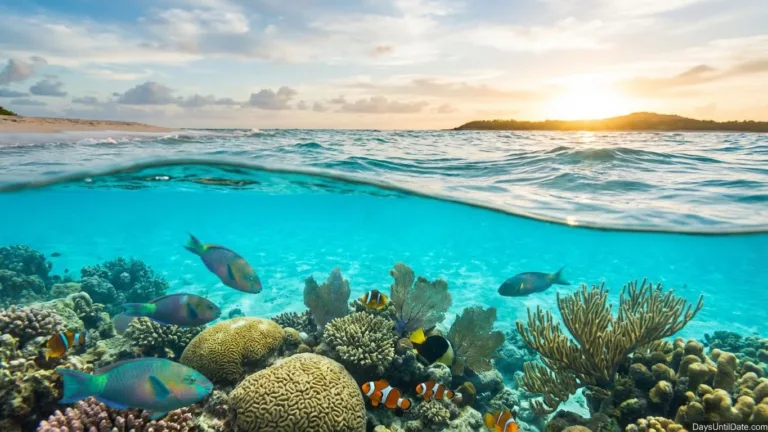
How many days until World Oceans Day?
World Oceans Day is on Tuesday, June 8, 2027. There are 223 days left until World Oceans Day. World Oceans Day is observed every year on June 8.
Date & Planning Details
World Oceans Day is observed every year on June 8.
Usually treated as an observance, not a day off.
World Oceans Day Calendar (2027-2100)
| Year | Date | Day | Days Left | Weekend? |
|---|---|---|---|---|
| 2027 | June 8 | Tue | 223 days | No |
| 2028 | June 8 | Thu | 589 days | No |
| 2029 | June 8 | Fri | 954 days | No |
| 2030 | June 8 | Sat | 1319 days | Yes |
| 2031 | June 8 | Sun | 1684 days | Yes |
| 2032 | June 8 | Tue | 2050 days | No |
| 2033 | June 8 | Wed | 2415 days | No |
| 2034 | June 8 | Thu | 2780 days | No |
| 2035 | June 8 | Fri | 3145 days | No |
What is World Oceans Day?
World Oceans Day is observed on June 8 each year to focus attention on the ocean, marine life, coastal communities, and the need to protect ocean ecosystems. It is used by schools, museums, conservation groups, local communities, and international organizations to plan education programs, cleanups, talks, and public campaigns.
How People Observe It
People mark World Oceans Day through beach and river cleanups, ocean literacy lessons, museum programs, film screenings, public talks, community science projects, art activities, and campaigns about plastic pollution, sustainable seafood, and marine protection.
History and Background
World Oceans Day grew from an ocean-focused idea proposed in the early 1990s into a United Nations-recognized international observance.
Frequently Asked Questions
When is World Oceans Day?
World Oceans Day is on June 8 every year.
Is World Oceans Day the same date every year?
Yes. The date is fixed, so it is always observed on June 8.
Is World Oceans Day a public holiday?
No. It is an international awareness day, not a public holiday.
Why is World Oceans Day important?
It helps people focus on ocean health, marine biodiversity, pollution, coastal communities, and practical ways to protect ocean ecosystems.
Who can take part in World Oceans Day?
Schools, families, local groups, museums, aquariums, conservation organizations, and individuals can take part through education, cleanup, and awareness activities.
What is a simple way to observe World Oceans Day?
A simple option is to learn about one local ocean or water issue, reduce single-use plastic, join a cleanup, or share reliable ocean education materials.
World Oceans Day Timeline
These milestones show how World Oceans Day became a widely recognized annual date.
The idea of World Ocean Day was promoted during the Earth Summit in Rio de Janeiro.
The Ocean Project began helping coordinate wider public participation around the annual date.
The United Nations General Assembly officially recognized June 8 as World Oceans Day.
The first United Nations-recognized World Oceans Day was observed on June 8.
More Upcoming Days



This countdown uses the selected timezone to keep the live timer and date table consistent.