Skip to content
Home » Until » How Many Days Until World Wildlife Day? (2027)

How Many Days Until World Wildlife Day? (2027)

Next event in

World Wildlife Day

327
00
00
00

World Wildlife Day Calendar (2026-2040)

YearDateDayDays Left
2027March 3Wed326 days
2028March 3Fri692 days
2029March 3Sat1057 days
2030March 3Sun1422 days
2031March 3Mon1787 days
2032March 3Wed2153 days
2033March 3Thu2518 days
2034March 3Fri2883 days
2035March 3Sat3248 days
2036March 3Mon3614 days
2037March 3Tue3979 days
2038March 3Wed4344 days
2039March 3Thu4709 days
2040March 3Sat5075 days

Every year on March 3, the calendar slips in a gentle reminder: wildlife isn’t “somewhere else.” It’s the sparrow that argues with your alarm clock, the tiny moth that shows up like it pays rent, the rosemary on a windowsill—alive, doing its quiet work.

Basic Facts

  • World Wildlife Day happens on March 3 each year.
  • It’s a UN observance that spotlights wild animals and plants and why they matter in daily life.
  • The 2026 theme is “Medicinal and Aromatic Plants: Conserving Health, Heritage and Livelihoods.”

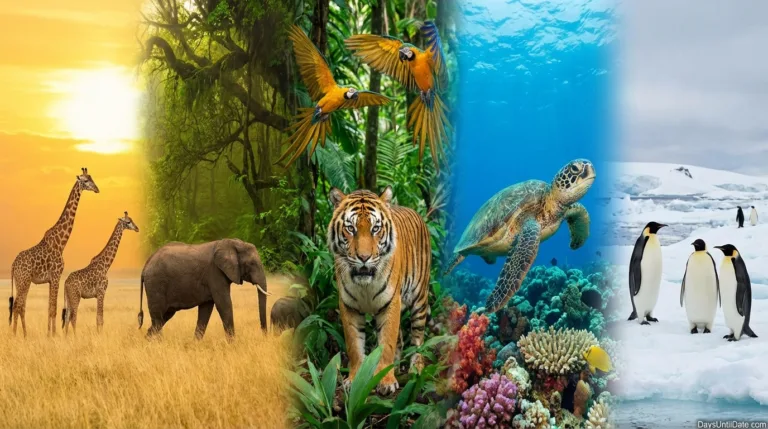
Wildlife includes more than big, famous animals. It also means wild plants, fungi, insects, small birds, and the life in streams and soil.

If it lives without being “owned” by someone, it usually counts—even when it shares space with people. City parks, roadside trees, empty lots. All of it.

What World Wildlife Day Is

World Wildlife Day is a simple idea with a steady heartbeat: notice wild species, learn what supports them, and treat their spaces like they matter (because they do). No big speeches required. Sometimes it’s just paying attention.

On paper, it’s “one day.” In real life, it’s a nudge to see that wildlife connects to food, clean water, and even the plants people use for well-being. And yes, it can feel small—until it doesn’t. That’s the trick.

Numbers That Make It Real

Data PointPlain Meaning for Daily Life
About 1 million species are estimated to face extinction riskMany plants and animals could vanish within decades without better care for habitats and use of nature.
Pollinators support US$235–577B in global food value each yearBees, butterflies, flies, and other helpers affect foods people actually eat (fruit, nuts, coffee, cocoa).
Between 50,000–80,000 flowering plant species are used for medicineHerbal knowledge pulls from a huge slice of plant life—gardens and wild places both matter here.
Roughly 15,000 of those medicinal plants are reported as threatenedSome useful plants need gentler harvesting and more growing-at-home or farm cultivation.
Global protected areas are about 17.6% on land and 8.4% in the oceanProtected places are growing, but there’s still lots of room to improve coverage and quality.
Since 2020, over 8,600 plant species have been newly named by sciencePeople are still discovering what exists—meaning there’s more to protect than most of us realize.
One recent estimate says 45% of flowering plant species may be at extinction riskPlants aren’t “background.” They are the base layer for many animals, and for people, too.

Those stats can sound heavy, honestly. So here’s a steadier way to hold them: small choices pile up, especially around plants, water, and green space. Little by little. That’s real.

Why The 2026 Theme Feels Practical

“Medicinal and Aromatic Plants” might sound like it belongs in a shop window, but it’s mostly about everyday plants: mint, thyme, lavender, sage, and thousands more that people use in teas, balms, and cooking. (And yes, some of them smell amazing.) Aromatics aren’t fancy—they’re familiar.

These plants also hold up wildlife in quiet ways. Flowering herbs feed pollinators; shrubs give cover; seed heads feed birds. A healthy ecosystem works like an orchestra: many parts, one shared rhythm, and you notice the silence when a section disappears. Plants lead.

There’s another angle people forget: many modern medicines trace back to natural compounds found in plants, fungi, and microbes. That doesn’t mean every leaf is a cure (it isn’t), but it does mean nature’s library has pages we haven’t read yet.

Wildlife Is Not Only “Out There”

Wildlife lives where life can live. Sometimes that’s a forest. Sometimes it’s the thin strip of trees behind a bus stop, the weedy corner by a parking lot, or a balcony planter that gets sun until noon. Messy green spots can be surprisingly busy. Very busy.

Picture a late afternoon walk where you hear a bird call you don’t recognize, then you spot the bird hopping—fast, a little dramatic—between branches. You stop for five seconds. That pause changes the whole day. It happens. That’s noticing.

When people say they “don’t see wildlife,” I think they usually mean they don’t see big wildlife. Fair. But ladybirds, geckos, hedgehogs in some places, bats at dusk—wildlife shows up in plain sight. Quietly, then all at once.

Notice first. Learn second. Act third.

Technology That Helps People Notice

In the last year or two, nature apps went from “niche hobby” to normal. One well-known community, iNaturalist, has recorded nearly 300 million observations and has passed 4 million people who’ve logged something. (I know, it sounds a bit nerdy. It’s also fun.)

Even pop culture leans in sometimes. For example, the 2026 World Nature Photography Awards pulled thousands of entries from 51 countries, and the winning shot featured a rare pale humpback calf. People still look at wildlife and go, “Wait—what is that?” Good. Keep that curiosity.

Wildlife-Friendly Choices That Fit Real Life

Let’s keep this grounded. You don’t need a farm, a forest, or a perfect schedule. You need a few habits that don’t fight nature all the time. That’s it. No biggie.

  • Plant natives when you can (even one pot). Native plants often feed local insects and birds better than imports.
  • Skip broad “kills-everything” garden chemicals; they don’t stop at the target. Choose narrow, gentle options when you must use anything at all.
  • Leave a little “wild corner” if you have space—fallen leaves, seed heads, a patch of grass that’s not shaved down weekly. Untidy can be useful.
  • If you keep pets, manage their outdoor time with care. It helps birds and smaller animals more than many people expect.
  • Make windows safer for birds with simple decals or screens. It’s a small fix with a clear payoff.

And if you want one choice tied to the 2026 theme, grow a few aromatic herbs and let some of them flower. Pollinators show up. They really do. Fast.

Common Questions People Ask

Do “medicinal plants” always mean rare plants?

No. Many are everyday species. The point is to value plant diversity—common plants, uncommon ones, and wild relatives—so use doesn’t outpace regrowth. Balance matters.

Is planting one balcony pot actually useful?

Yes, especially if it blooms. One pot won’t “save” everything (obviously), but it can feed insects that feed birds, and it can change what you notice day to day. That shift is underrated. Very underrated.

How do I know if a plant choice supports wildlife?

Look for local guidance, native plant lists, and signs of life: bees visiting, butterflies landing, birds picking seeds. When a plant draws repeat visitors, you’re on the right track. Simple test.

World Wildlife Day doesn’t ask for perfection. It asks for attention, then a little care, then a little more. Some days you’ll do a lot; some days you’ll do almost nothing—still counts. Keep noticing.

Leave a Reply

Your email address will not be published. Required fields are marked *